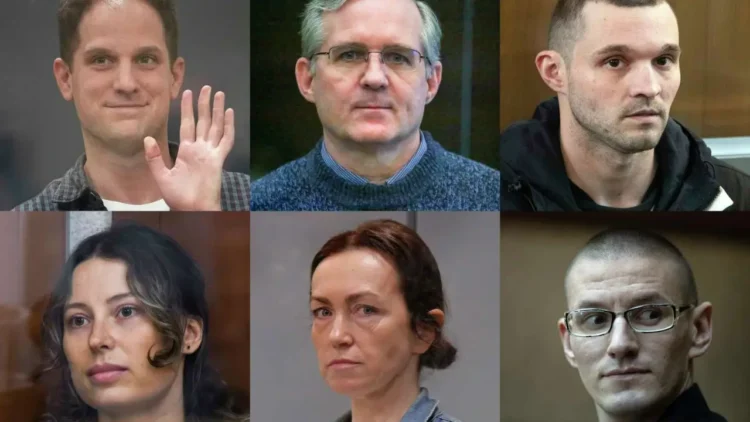
In an unprecedented move reminiscent of Cold War-era diplomacy, the largest prisoner exchange between Russia and the West in decades took place on August 1, 2024. A total of 24 individuals were exchanged in a deal that has been in the works for over 18 months, highlighting the complexities and high stakes of modern international relations.
The White House confirmed that 16 prisoners, including Wall Street Journal reporter Evan Gershkovich, are on their way back to Europe and the United States. In return, eight Russians held in various Western prisons have been released and are heading back to Russia. The swap was executed on the runway of Ankara airport in Turkey earlier today under the supervision of Turkish security officials.
“Some of these women and men have been unjustly held for years. All have endured unimaginable suffering and uncertainty. Today, their agony is over,”
President Joe Biden
President Joe Biden addressed the public, describing the exchange as a “feat of diplomacy” and expressing relief that these individuals, many of whom have endured years of uncertainty and hardship, are finally returning home.
Among those freed is US Marine veteran Paul Whelan, who had been held in Russia since 2018 on espionage charges. Also released were Russian-American journalist Alsu Kurmasheva and Russian-British activist Vladimir Kara-Murza, both of whom have faced severe repercussions in Russia for their work. German citizen Rico Krieger, who had been sentenced to death in Belarus but was later pardoned, and Russian political prisoner Ilya Yashin were also among those exchanged.
The negotiation process for this exchange was protracted and challenging, with discussions intensifying over the past few months. The deal reportedly hinged on Moscow’s demand for the return of Vadim Krasikov, a suspected Russian agent who was serving a life sentence in Germany for the 2019 assassination of a Kremlin opponent in Berlin. Krasikov’s release was a key element of the negotiations, making this one of the most complex exchanges in recent history. A senior US administration official referred to Krasikov as a “bad dude” and noted that he was “certainly the biggest fish the Russians wanted back.”
The Turkish presidency, which facilitated the exchange, confirmed that the prisoners were taken off aircraft at Ankara airport and moved to secure locations before boarding planes to their respective destination countries. The swap included 26 individuals according to Turkish sources, a figure that encompasses two children likely belonging to Artyom Dultsev and Anna Dultseva, a Russian couple convicted of spying in Slovenia.
This exchange is the largest of its kind since the Cold War and underscores the ongoing tensions between Moscow and the West, particularly in light of Russia’s invasion of Ukraine in February 2022. The last comparable exchange occurred in December 2022, when US basketball star Brittney Griner was exchanged for Russian arms dealer Viktor Bout, who had been imprisoned in the US for 12 years. Another notable exchange happened in Vienna in 2010, when 10 Russian spies held in the US were swapped for four alleged double agents held in Russia, including Sergei Skripal, who was later poisoned by the nerve agent Novichok in Salisbury in 2018.
The implications of this exchange are likely to resonate for some time, given the current geopolitical climate. With no official confirmation from Moscow yet, the details of this exchange continue to unfold, revealing the delicate nature of such negotiations and the intricate web of international relations that underpin them.